The Deep Seabed Is Not Empty
Introduction
The deep ocean is increasingly framed as the next great resource frontier even as science keeps revealing how little we know about it. Deep-sea mining is often framed as a practical answer to future mineral demand, but that framing depends on imagining the seabed as empty, governable and available for extraction. Recent discoveries in ultra-deep trenches make that assumption harder to defend. At the same time, the new High Seas Treaty is pushing ocean politics further toward biodiversity protection, even if mining itself still sits outside its direct scope. The key question is not just whether the seabed can be mined, but why it has been made to look mineable in the first place.
The Seabed as an “Empty Frontier”
Deep-sea mining is often presented as a new frontier, as a source of untapped minerals, strategic necessity, and new supply for future technologies. Yet, as critical researchers show, this language does more than describe the seabed, it actively produces it as an extractive space. Mining then is not simply about accessing resources, but about reimagining the seabed in spatial and political terms as available, valuable, and governable. From this perspective, the deep ocean is framed less as a complex and uncertain environment than as a new extractive zone waiting to be organised and exploited. Mining is also legitimised not only through science and law, but also through politically consequential discourses such as “blue growth,” “resource frontier,” and “resource security.” The problem then, is that the “frontier” idea converts limited knowledge into apparent availability, making industrial extraction seem like common sense rather than a deeply political choice.
What Deep-Sea Mining Involves
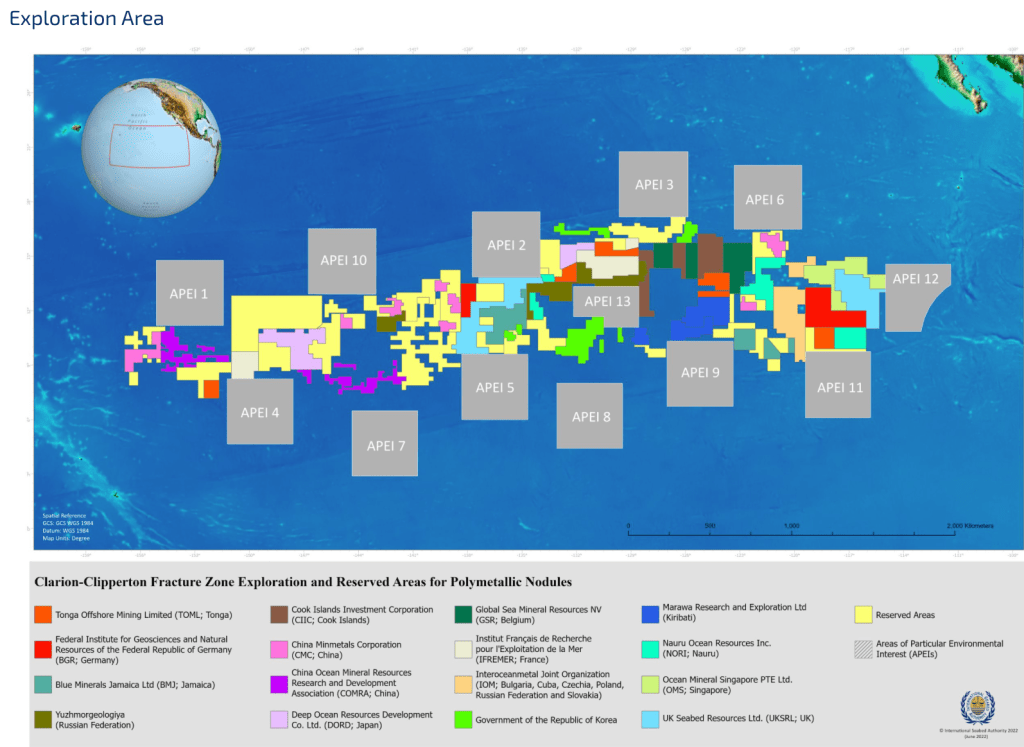
Deep-sea mining refers to the proposed extraction of mineral resources such as polymetallic nodules, polymetallic sulphides, and cobalt-rich ferromanganese crusts from the seabed. Interest in these resources has grown because they contain metals such as nickel, copper, and cobalt, which are now treated as strategically important to energy, technology, and industrial supply chains. But deep-sea mining is not simply a technical matter. In areas beyond national jurisdiction, mining sits within a legal and institutional framework shaped by UNCLOS and administered by the International Seabed Authority (ISA), which organises and controls mineral-related activities in “the Area” . Deep-sea mining is therefore not only about extraction, but also about the geographies, actors, and governance arrangements that make extraction possible.
Why the Unknown Is Not Empty
That fragmented system is becoming more politically charged as commercial and geopolitical pressure for deep-sea mining grows. Marine biodiversity governance may be expanding, but it remains shaped by geopolitical struggle, unilateral action, and competing visions of what the ocean is for. That tension is already visible in current debates over whether precaution or mineral security should guide ocean governance. The treaty may strengthen opposition to deep-sea mining by reinforcing precautionary thinking and giving momentum to new protected areas, even as some states push in the opposite direction. At the same time, major powers increasingly frame critical minerals as a strategic resource issue, linking them to supply-chain security and dependence on China. The question, then, is whether the rush for critical minerals is outrunning both the science needed to understand the deep ocean and the politics needed to protect it.

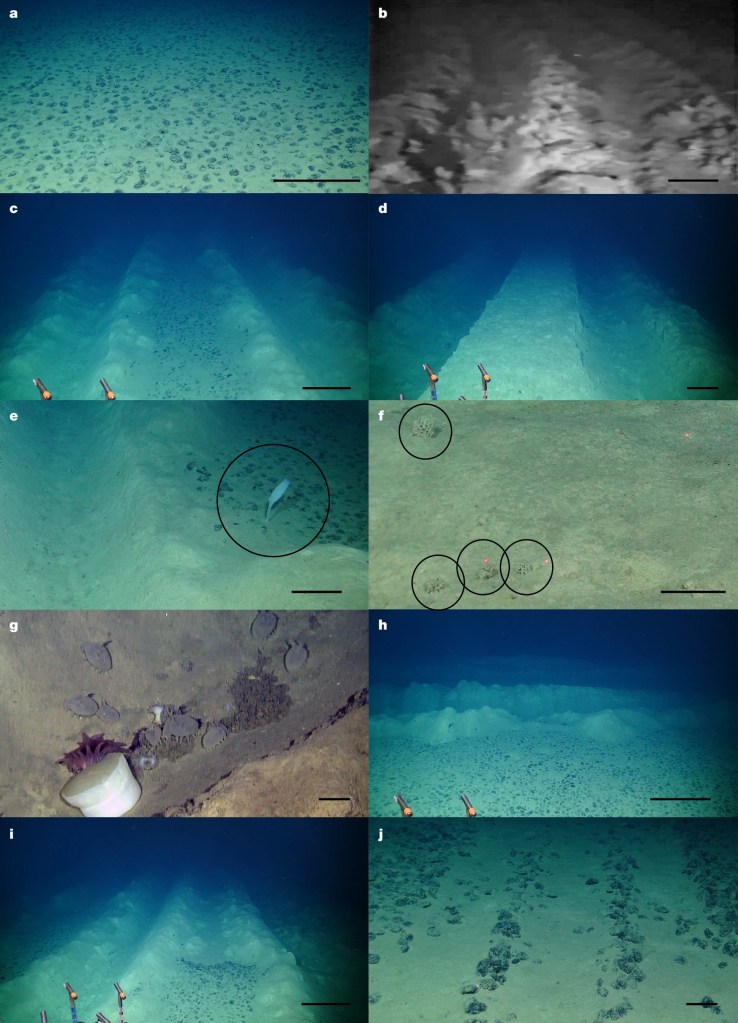
The problem with seeing the deep seabed as blank space is that ignorance does not mean absence. In fact, recent research continues to reveal how much remains unknown about deep-sea ecosystems. Findings from the Kuril-Kamchatka Trench, for example, documented thriving animal communities at depths of more than 10,000 metres in a place often assumed to be almost lifeless. That matters politically as much as scientifically, because it challenges the idea that poorly understood environments are somehow empty and therefore available for extraction.
The danger of acting on that assumption is clear from evidence of experimental deep-sea mining disturbance. Biological impacts were still visible 44 years later, and disturbed communities remained altered despite some recolonisation. This means that species, genetic material, ecological processes, and biochemical functions could be damaged or lost before they are even identified. As it is argued, the sea cannot be reduced to a flat surface or resource frontier, it must be understood as a submerged, multispecies environment with its own “sea ontologies.” In this sense, uncertainty is political, because it shapes how risk is judged and whether the unknown is treated as something to protect or something to exploit. Uncertainty then, should not be treated as a green light for mining, but as a reason to hesitate.
A Fragmented System of Ocean Governance
The High Seas Treaty strengthens biodiversity governance in areas beyond national jurisdiction through tools such as marine protected areas and environmental impact assessments. However, it does not directly regulate deep-sea mining, which remains under the authority of the ISA. That matters because the ISA’s Mining Code remains the main framework for regulating prospecting, exploration, and any future exploitation of minerals in “the Area.” In other words, conservation and extraction continue to be governed through separate, overlapping legal regimes.
Conclusion
Deep-sea mining is often sold as a necessary step toward the future, yet that story depends on treating the seabed as empty space waiting to be used. The seabed is not an empty surface waiting for use, but a living and still only partially understood environment. At the same time, new biodiversity governance makes extractive claims harder to separate from questions of protection and precaution. The future of deep-seabed mining therefore turns not only on technology or law, but on whether uncertainty is treated as permission to extract or as a reason to pause.
Bibliography
Amon, D.J., Gollner, S., Morato, T., Smith, C.R., Chen, C., Christiansen, S., Currie, B., Drazen, J.C., Fukushima, T., Gianni, M., Gjerde, K.M., Gooday, A.J., Grillo, G.G., Haeckel, M., Joyini, T., Ju, S.-J., Levin, L.A., Metaxas, A., Mianowicz, K. and Molodtsova, T.N. (2022). Assessment of scientific gaps related to the effective environmental management of deep-seabed mining. Marine Policy, [online] 138(105006), p.105006. doi:https://doi.org/10.1016/j.marpol.2022.105006.
Angèle Ingrand, Team, F. and Team, A.I. (2026). Over 10 km under the ocean Chinese scientists uncover something beyond imagination – Futura-Sciences. [online] Futura-Sciences. Available at: https://www.futura-sciences.com/en/over-10-km-under-the-ocean-chinese-scientists-uncover-something-beyond-imagination_20806/.
Bell, K.L.C., Johannes, K.N., Kennedy, B.R.C. and Poulton, S.E. (2025). How little we’ve seen: A visual coverage estimate of the deep seafloor. Science Advances, 11(19). doi:https://doi.org/10.1126/sciadv.adp8602.
Carver, R., Childs, J., Steinberg, P., Mabon, L., Matsuda, H., Squire, R., McLellan, B. and Esteban, M. (2020). A critical social perspective on deep sea mining: Lessons from the emergent industry in Japan. Ocean & Coastal Management, [online] 193, p.105242. doi:https://doi.org/10.1016/j.ocecoaman.2020.105242.
Childs, J. (2018). Extraction in Four Dimensions: Time, Space and the Emerging Geo(-)politics of Deep-Sea Mining. Geopolitics, 25(1), pp.189–213. doi:https://doi.org/10.1080/14650045.2018.1465041.
Childs, J. (2022). Geographies of deep sea mining: A critical review. The Extractive Industries and Society, p.101044. doi:https://doi.org/10.1016/j.exis.2022.101044.
Chinese Academy of Sciences (2025). Chinese-led Team Discover ‘vibrant oasis’ of Chemical-eating Creatures 10,000 m Undersea—-Chinese Academy of Sciences. [online] English.cas.cn. Available at: https://english.cas.cn/newsroom/cas_media/202508/t20250801_1048883.shtml.
DeLoughrey, E. (2017). Submarine Futures of the Anthropocene. Comparative Literature, [online] 69(1), pp.32–44. doi:https://doi.org/10.1215/00104124-3794589.
Friedman, S. (2024). The interaction of the BBNJ agreement and the legal regime of the Area, and its influence on the implementation of the BBNJ agreement. Marine policy, 167, pp.106235–106235. doi:https://doi.org/10.1016/j.marpol.2024.106235.
International Seabed Authority (2022). The Mining Code – International Seabed Authority. [online] International Seabed Authority – International Seabed Authority. Available at: https://isa.org.jm/the-mining-code/.
Jones, D., Arias, M.B., Audenhaege, V., Blackbird, S., Boolukos, C., Bribiesca-Contreras, G., Copley, J.T., Dale, A., Evans, S., Bethany, Gates, A.R., Grant, H., Mark, Huvenne, Veerle A. I, Jeffreys, R.M., Josso, P., King, L.D., Simon-Lledó, E., Bas, L. and Norman, L. (2025). Long-term impact and biological recovery in a deep-sea mining track. Nature, [online] pp.1–3. doi:https://doi.org/10.1038/s41586-025-08921-3.
Peng, X., Du, M., Andrey Gebruk, Liu, S., Gao, Z., Glud, R.N., Zhou, P., Wang, R., Rowden, A.A., Kamenev, G.M., Maiorova, A.S., Papineau, D., Chen, S., Gao, J., Liu, H., He, Y., Alalykina, I.L., Igor Yu Dolmatov, Zhang, H. and Li, X. (2025). Flourishing chemosynthetic life at the greatest depths of hadal trenches. Nature. [online] doi:https://doi.org/10.1038/s41586-025-09317-z.
Peters, K. and Vadrot, A.B.M. (2025). Editorial: Social science perspectives on marine biodiversity governance. Frontiers in Marine Science, 12. doi:https://doi.org/10.3389/fmars.2025.1724090.
Scheyder, E. and Renshaw, J. (2025). Trump signs executive order boosting deep-sea mining industry. Reuters. [online] 24 Apr. Available at: https://www.reuters.com/business/energy/trump-expected-sign-deep-sea-mining-executive-order-thursday-sources-2025-04-24/.
UN Treaty (2025). Agreement under the United Nations Convention on the Law of the Sea on the Conservation and Sustainable Use of Marine Biological Diversity of Areas beyond National Jurisdiction. Ocean Yearbook Online, [online] 39(1), pp.773–835. doi:https://doi.org/10.1163/22116001-03901028.
Who Controls a Melting Arctic? The Politics of the Northern Sea Route
Introduction
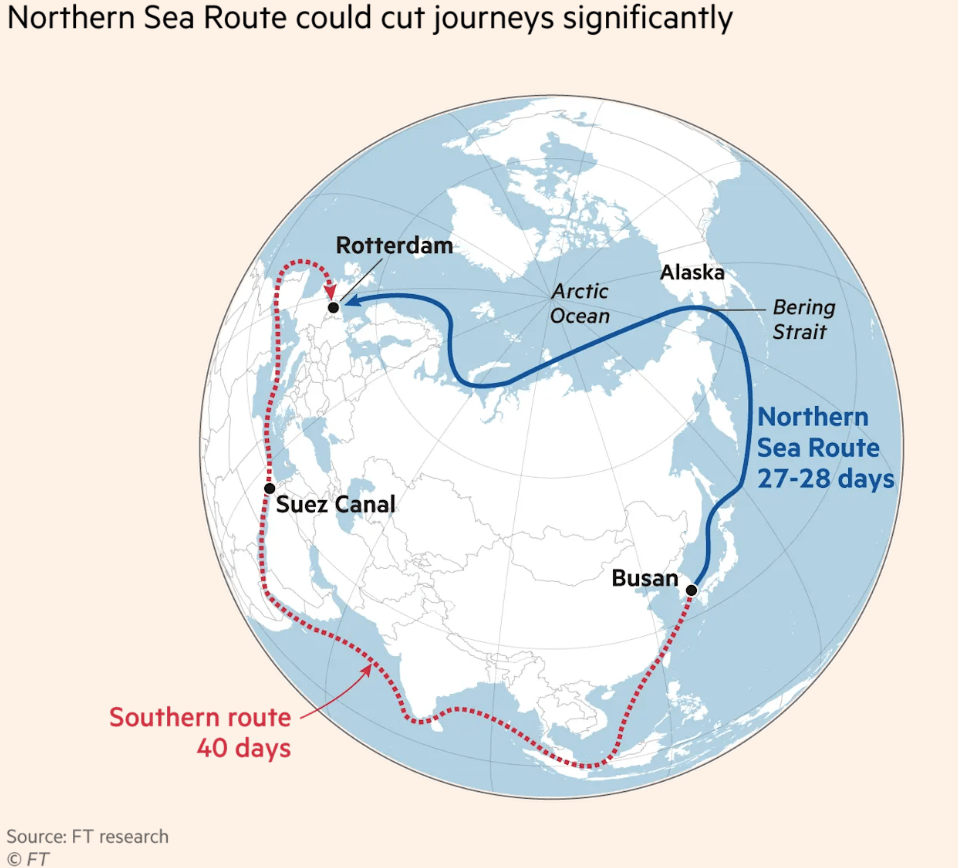
The Arctic is often described as “opening” as sea ice retreats, with the Northern Sea Route given as proof that climate change is creating a new trade corridor between Europe and Asia that cuts the journey time significantly (Figure 1). But that story is too simple. What is changing is not just access. It is the whole material order that used to organise the region. Sea ice once acted as a barrier that slowed movement, limited navigation and shaped military planning. As that barrier weakens, the Northern Sea Route is being perceived not as a neutral shortcut but as a corridor to be monitored, controlled and defended. The real politics of a melting Arctic is not about a route suddenly becoming available, it is about who gets to turn a changing environment into authority.
The “opening Arctic” story hides a struggle over control
The problem with the “opening Arctic” narrative is not that it is entirely wrong. It is that it mistakes a strategic struggle for a simple geographic opportunity. It is argued that Arctic geopolitics is produced through “space-making practices,” not merely revealed by melting ice. Another idea is explored that “the thaw” is not just physical change, but a framing device that organises the region around access, circulation and opportunity. That is useful because, once the Arctic is imagined mainly as a route, the key political question quietly shifts from whether the region is changing, to who will control movement through it. Recent information on NATO’s Arctic planning and the Arctic’s changing “physics” points in exactly that direction, the issue is no longer only new passage, but the strategic instability created when older barriers stop doing the work they once did.
The Northern Sea Route is not just shorter, it is governable only through infrastructure
That is why the Northern Sea Route matters politically. A shipping lane through unstable ice is not useful simply because it exists on a map. It becomes useful only when it can be rendered predictable through icebreakers, permits, surveillance, communications and legal claims. This is where work on Arctic mapping (figure 2), is helpful as their point is not just that maps represent the Arctic, but that they help produce it as an ordered space in the first place.
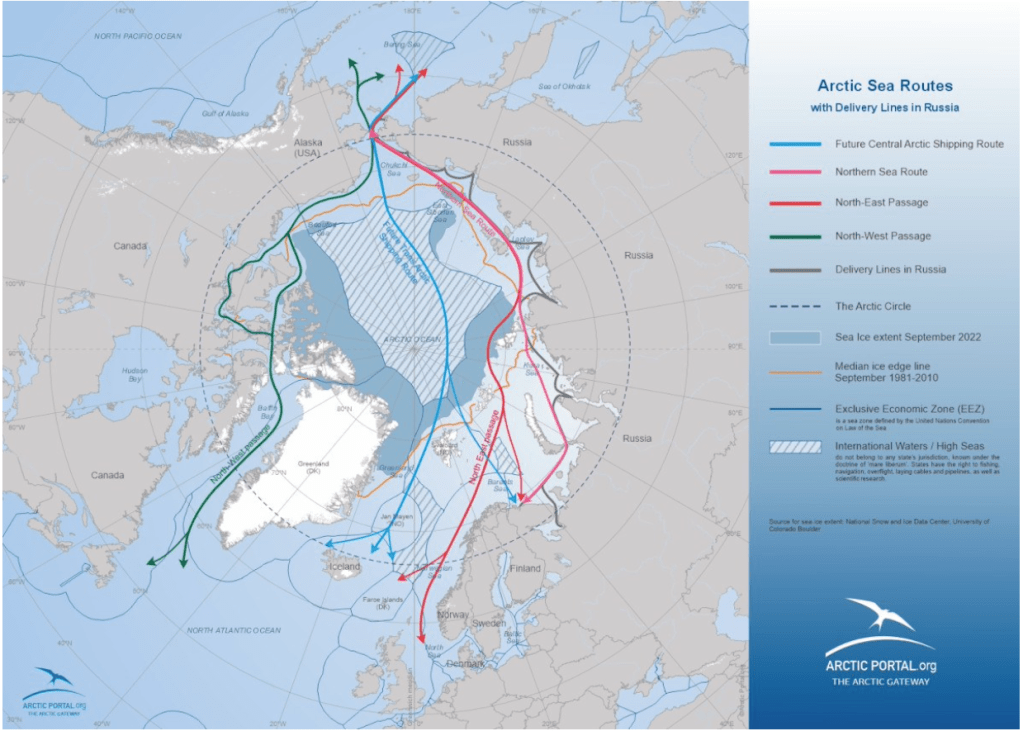
The US Department of Defense now treats that ordering work as a security issue. Its 2024 Arctic Strategy adopts a “monitor-and-respond” approach and explicitly warns that Russia’s maritime infrastructure could be used to enforce “excessive and illegal maritime claims” along the Northern Sea Route. In other words, the route is not politically important because the ice is melting. It is politically important because Russia can try to convert physical change into administrative and military leverage.
Russia is selling the route, but the route is still fragile
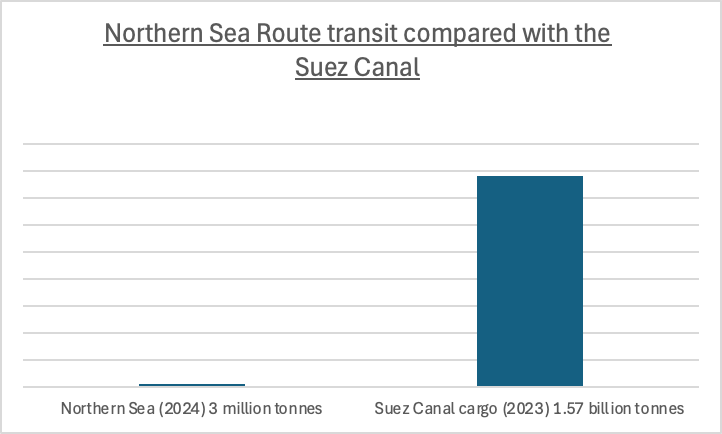
This is where the current examples really matter. Russia is actively trying to market the Northern Sea Route as a strategic alternative to Suez as sanctions push trade towards Asia. Rosatom is expected a 50% rise in foreign vessel voyages and promoted the route as saving up to 10 days compared with the Suez Canal. But that ambition runs into a stubborn reality as the route is still commercially narrow, seasonal and highly dependent on Russian support infrastructure. Reports note that in 2024 only 3 million tonnes of cargo transited the route, compared with 1.57 billion tonnes through Suez the year before, while major container lines remain wary because of ice risk, sanctions exposure, weak cargo hubs and reliance on Russian icebreakers. That gap is analytically useful. It shows that the Northern Sea Route is politically oversized relative to its actual commercial maturity. States talk about it as a transformative corridor precisely because controlling even a limited route can generate strategic advantage.
This is why US-Russia tension now focuses on the Arctic corridor
Seen in that perspective, recent US-Russia tension is not a side issue. It is the point. NATO now describes the Arctic as an area of increasing strategic competition, noting Russia’s new Arctic Command, reopened airfields and deep-water ports, and testing of new weapons systems. In February 2026 NATO launched Arctic Sentry to coordinate allied activity across the High North. Russia, meanwhile, continues to frame Western activity as a direct Arctic security threat, for instance, in March 2026 its foreign ministry accused the West of increasing military pressure in the region and raising the risk of confrontation. The Northern Sea Route sits inside that tension. It is where shipping, military infrastructure and legal claims meet. So the Arctic is not becoming strategically important because a trade route may emerge one day. It is becoming strategically unstable because a still-fragile route is being folded into rivalry between Russia and the western alliance right now.
The governance problem is growing faster than the institutions
That also explains why there is a lack of governance. The IMO’s Polar Code matters, but its purpose is limited. It sets mandatory rules for ship safety and pollution prevention, alongside operational, training, search-and-rescue and environmental requirements for vessels in polar waters. It helps regulate movement through dangerous waters. But it does not settle who gets to define and control the corridor politically. The Arctic Council does not fully fill that gap either. Its Chair confirmed in 2026 that political-level meetings have been on pause since 2022, even though Working Group meetings resumed virtually after a 2024 decision to restart project-level work. There is a clear gap between the scale of the problem and the institutions available to manage it. Strategic competition around the Northern Sea Route is intensifying, just as the main bodies for Arctic cooperation remain confined to narrower, more technical roles and are not equipped to handle rising geopolitical tension.
Conclusion
So the Arctic is not simply “opening.” It is being re-ordered. The Northern Sea Route is the clearest expression of that shift, an unprepared highway created by melting ice, but a contested corridor whose value depends on surveillance, infrastructure, legal claims and military position. That is why the most important question is not whether climate change makes Arctic shipping more possible. It is who gets to turn that possibility into control. Once that is clear, the Arctic looks less like a new commercial frontier and more like a struggle to govern mobility in a region where the old material order is breaking down.
Bibliography
Arctic Council (2024). Arctic Council advances resumption of project-level work. [online] Arctic Council. Available at: https://arctic-council.org/news/arctic-council-advances-resumption-of-project-level-work/.
Arctic Council (2026). A 2026 Arctic Council Update from the Chair of the Senior Arctic Officials. [online] Arctic Council. Available at: https://arctic-council.org/news/2026-arctic-council-update/.
Arctic portal (2022). Arctic Sea Routes with delivery lines in Russia – Full information – Arctic Portal – The Arctic Gateway. [online] Arctic Portal – The Arctic Gateway. Available at: https://arcticportal.org/maps/download/maps-shipping/3296-arctic-sea-routes-with-delivery-lines-in-russia-full-information.
Bruun, J.M. and Medby, I.A. (2014). Theorising the Thaw: Geopolitics in a Changing Arctic. Geography Compass, 8(12), pp.915–929. doi:https://doi.org/10.1111/gec3.12189.
Dittmer, J., Moisio, S., Ingram, A. and Dodds, K. (2011). Have you heard the one about the disappearing ice? Recasting Arctic geopolitics. Political Geography, [online] 30(4), pp.202–214. doi:https://doi.org/10.1016/j.polgeo.2011.04.002.
IMO (2026). International Code for Ships Operating in Polar Waters (Polar Code). [online] http://www.imo.org. Available at: https://www.imo.org/en/OurWork/Safety/Pages/polar-code.aspx.
Krampe, F. (2026). The changing physics of the Arctic are the real defence threat. [online] Financial Times. Available at: https://www.ft.com/content/b44f12c2-7468-45e9-ab6a-7ddd18658405.
Medby, I.A., Kristoffersen, B., Steinberg, P., Dodds, K., Bennett, M.M., Bruun, J.M. and Kontou, D.-M. (2025). Polar projections: Political geographies of Arctic mapping. Political Geography, [online] p.103391. doi:https://doi.org/10.1016/j.polgeo.2025.103391.
Milne, R. and Stognei, A. (2026). How Nato is preparing for war in the Arctic. [online] Financial Times. Available at: https://www.ft.com/content/4130ee07-5586-47bc-8631-f0d055e63ce7.
NATO (2026a). Arctic security. [online] Available at: https://www.nato.int/en/what-we-do/deterrence-and-defence/arctic-security.
NATO (2026b). NATO announces Arctic Sentry – enhancing NATO’s presence in the Arctic and the High North. [online] ac.nato.int. Available at: https://ac.nato.int/archive/2026/nato-announces-arctic-sentry-enhancing-natos-presence-in-the-arctic-and-the-high-north.
Reuters (2026). Russia accuses the West of creating security threats for Moscow in the Arctic. Reuters. [online] 18 Mar. Available at: https://www.reuters.com/world/russia-accuses-west-creating-security-threats-moscow-arctic-2026-03-18/.
Reuters Staff (2025). Russia’s Rosatom expects boom in foreign vessels using Arctic shipping route. Reuters. [online] 30 May. Available at: https://www.reuters.com/world/china/russias-rosatom-expects-boom-foreign-vessels-using-arctic-shipping-route-2025-05-30/.
Wright, R. (2025). Shipping lines go cool on Arctic Ocean route. [online] Financial Times. Available at: https://www.ft.com/content/90c5257c-4358-471f-9acc-01a2901c2828.
 Site Title